Showing posts with label television. Show all posts

Thursday, November 19, 2009

TiVo

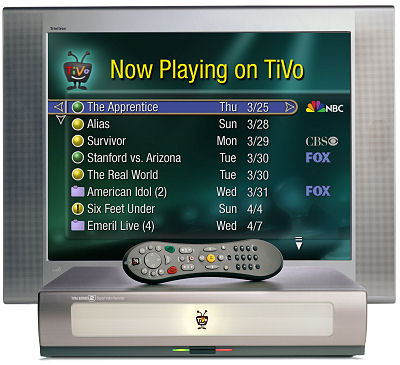
We have already ranted against television. Your life is much richer without it! But what about "concentrated television", where you can replay shows at your own convenience and zap out the ads?

Services like TiVo and DishPVR allow you to "timeshift" your viewing and perhaps do it more efficiently, but the underlying programming is still the same. Television in any form displaces your own thoughts with someone else's. Instead of thinking about your own problems and your own productivity, you're sucked into a script provided by others.

Television and other sensory addictions subdivide your consciousness, which is a finite commodity. The more things you try to attend to, the lower the quality of that attention will be. If you are keeping track of the lives of dozens of fictional characters and stories, then you can't be attending as well to the real characters and stories of your own life.

Watching concentrated television is akin to taking concentrated drugs. You're cramming more sensory stimulation into a shorter period of time, with even less time to process it. Furthermore, when you can timeshift your television, you'll never miss your favorite shows. You'll see ALL of them! If you pre-program your shows in advance, you will come back later to have them all waiting for you. This is like having a big buffet in front of you. How can you resist eating it all?

Back in the old days, you had to be in front of the TV at the time the show was broadcast. If there were conflicts with other shows or with real activities in your own life, then you simply missed the show. Is this such a bad thing? Schedule conflicts and the pain of having to watch the ads were natural limiting factors on how much TV you watched. Concentrating the television just makes it easier to watch and more irresistible for most people. Like concentrated food, TiVo encourages "data obesity" where people overindulge to the point where their true quality of life is very poor.

It doesn't matter if a drama is "good", a comedy is "funny" or a documentary is "informative." There may be a lot of admirable shows on television. The only question is whether they are the best thing you could be doing with your limited time on Earth.


Also see: Mindless Entertainment Wasting Our Planet (Kilroy Cafe #16)

Friday, January 9, 2009

Television

Parasitic brain-sucking device. You don’t need it!

In the modern age, video is unavoidable. It’s everywhere, but you don’t need to invite this parasite into your home.

Television CAN be educational. It CAN give you access to other people’s lives and parts of the world that you might not otherwise experience, but it is also a powerful addictive substance that can quickly become a substitute for real life.

Television force-feeds us a steady stream of emotional images, so many that we don’t have time to process them. Even an “educational” show needs time to sink in, and if you move immediately to the next show and the next, you’re never going to have the time to derive any nutritional value from what you have seen.

Television promotes a sort of information obesity. It’s junk food for the mind. Like having a refrigerator full of goodies, having a TV in your home invites bingeing. You won’t just consume one show a week; you’ll take in dozens—with the same queasy feeling like you’ve eaten too many Twinkies.

For the health of your brain, television is something best taken in very small doses (like a half-hour a week), and the best way to control it is to not have one.

Don’t worry, you won’t be missing anything! You’ve already seen plenty of TV, right? You can just extrapolate from your past experience to imagine the current season. There will be drama. Characters will get themselves into messes and then get out of them, but you will have gained nothing by watching.

Television exploits the same emotional circuitry use for real relationships, except it is only a pseudo-relationship. These characters can’t really interact with you, and you have no influence over them.

Why not interact with life FOR REAL? Every hour spent in front of the TV is not being spent on real pursuits.

If you don’t have a TV yourself, you’ll still see plenty of it, since your friends probably have it, and it is everywhere in public places. All those movies you’re missing? You can catch them in the theater or play them on DVD on your computer—when you are ready. One good movie a month ought to be enough to keep you stimulated without overstimulation.

In spite of TV’s educational potential, the primary conveyance for ideas is still the written word. If what you read leads you to a piece of video that you really must see, you will find a way to view it.

Even educational shows can be an addiction. Like dramas, they are non-interactive and non-responsive. You are not really using the knowledge for anything, just collecting it obsessively.

Television should not be guiding your experience of the world, because it is a highly distorted reality. If you experience the world through television, you may think you know what life is like but you really don’t have a clue. When you eventually have to deal with real life, you’re going to fall flat on your face.

Television is not reality but an artificial simulation of it. It’s better to break out of the simulation and experience life directly.